
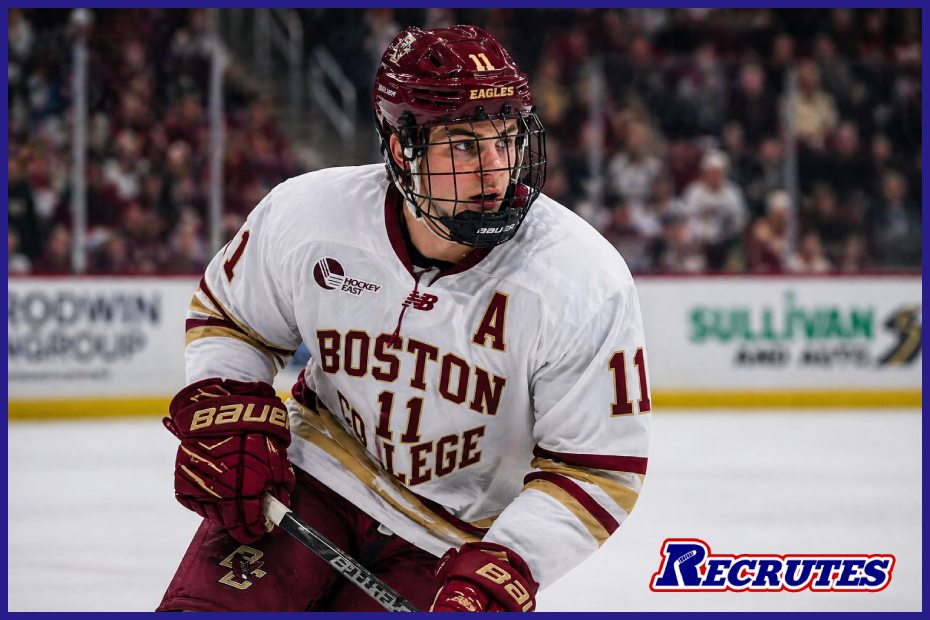
There are certain players you watch once and immediately go back to watch again.
Will Smith is one of those players.
What stands out first isn’t just skill, it’s how comfortable he looks controlling the pace of a shift. Some players react to the game. Smith tends to stay a step ahead of it, especially when the puck is on his stick.
Following his transition into the NCAA at Boston College, I’ve been paying closer attention to how his game is evolving against older, stronger competition. That adjustment phase usually tells you more than junior production ever will.
First impressions that actually hold up over time
A lot of prospects look dynamic in junior hockey, but the real test is whether those same habits translate when space disappears.
With Smith, the interesting part is that his strengths don’t rely on time and space. They come from how quickly he processes options.
What I keep noticing in his game:
- he scans before receiving the puck
- he rarely forces plays into traffic
- he adjusts pace instead of rushing decisions
- he creates passing lanes rather than waiting for them
Those are habits that usually translate at higher levels.
His playmaking isn’t just skill, it’s timing
There’s a difference between making a good pass and making the right pass at the right moment.
Smith leans toward the second category.
He doesn’t just move the puck quickly. He delays just enough to pull defenders out of position, then makes plays that open space for teammates.
That timing becomes more noticeable in the NCAA because defenders close faster and mistakes get punished more often.
A few patterns I’ve noticed repeatedly:
1 he draws pressure before distributing
2 he uses small changes in speed to create separation
3 he keeps plays alive instead of forcing low-percentage passes
4 he supports plays after passing instead of drifting out
That last point is something I always pay attention to. Players who stay involved after moving the puck tend to drive more consistent offense.
Skating supports everything else in his game
Smith isn’t the fastest player in a straight line, but that’s not really the point.
What matters is how he moves within the play.
His skating works because:
- he changes direction quickly without losing control
- he stays balanced through contact
- he keeps his head up while moving
- he adjusts pace instead of always pushing speed
That type of mobility fits well in modern systems where quick adjustments matter more than raw speed.
The NCAA environment is forcing useful adjustments
One thing I always look for is how a player reacts when things stop coming easily.
At Boston College, Smith isn’t facing junior defenders anymore. He’s dealing with older players who close space faster and play more structured systems.
That forces a few important changes:
- less time to hold the puck
- quicker decisions in transition
- more responsibility away from the puck
- less reliance on pure skill
So far, he’s handling that transition the right way.
He’s not trying to do too much. He’s adjusting his game instead of forcing it.
What still needs to develop
No prospect is complete at this stage, and with Smith, the areas for improvement are fairly typical for a player with his profile.
Things I’m watching moving forward:
- consistency in physical battles
- decision-making under heavy pressure
- defensive positioning in extended shifts
- maintaining impact when space is limited
These are the details that usually determine how quickly a player can handle the NHL level.
Why his projection remains strong
Players who rely only on skill tend to hit a ceiling when the game gets faster.
Players who think the game well usually find ways to adjust.
Smith falls into that second category.
His game isn’t built on one dimension. It’s built on reading the play, managing pace and making decisions that keep possession alive.
That combination gives him flexibility in how he can be used at higher levels.
Final thoughts about will
What makes Will Smith interesting isn’t just what he does when things are working.
It’s how he adjusts when they’re not.
That’s usually the difference between a good prospect and one who can handle the transition to the NHL.
There’s still development ahead, but the foundation is there. And players with that kind of awareness tend to figure things out as the level increases.
That’s why he’s one of the more interesting NCAA prospects to follow right now.